2025 Bowman Draft: HobbyMonitor’s Top Chases and Recommendations
How We Approach Bowman (and Why)
Card collecting takes many forms. Some collectors rip and hold, others enjoy the thrill of breaks, some focus on investing, and many prefer building their collections through singles.
At HobbyMonitor, we sit somewhere in the middle of all of that. We love cards, we love prospects, there’s nothing wrong with buying a box or joining a break but we try to stay realistic about where value actually comes from over time in the hobby.
For Bowman specifically, we usually employ a mix of strategies:
- Open some sealed product or participate in lower-cost random team breaks
- Target specific prospects through pick-your-player or team breaks where pricing makes sense
- Buy the majority of cards we want as singles several months after release, once hype settles and supply increases
Bowman is not a product where spreading thin across every single prospect works well especially at release. A disciplined, selective approach matters more here than almost any other Bowman release. Waiting until even early March (release is January 14th), can lead to some significant savings then buying anything in January.
Some Guidelines We Stick To
These are not hard rules for everyone, but they are guardrails that have served us well over time.
- Most base autos should be sold at release. Release week pricing is almost always the high water mark. We’ll flip nearly any prospects within a 1–2 week window around release. We use those funds to consolidate into lower-numbered color like True Blue /150 or True Gold /50 (and generally the more “liquid” colors, not the less desirable one-off parallels). If buying raw, we only do so when the card has a strong chance to grade well, and even then risk is part of the equation. In practice, we sell nearly all base autos we pull at release and only grade clean copies of the top prospects that will hold their value better. The only real exceptions are a true top-tier bat we’d happily hold anyway, or genuinely scarce color we’re comfortable sitting on.
- Limited budget? Buy singles after the release wave and in the offseason. This stretches dollars the furthest. Bowman Draft is a long game. Many of these players will not meaningfully move in value for 12 to 24 months. Waiting allows you to buy conviction rather than hype.
- We cannot chase everything. Both budget and attention are finite. We are content keeping a small number of prospects from sealed product and random team breaks, focusing on numbered autos or color /150 or lower. If we miss, the offseason provides opportunities to adjust without forcing decisions early. We’d rather be right on a handful of names than vaguely interested in a dozen. I do tend to keep non-auto parallels of random prospects, but there’s far less risk associated with doing so.
- Pitchers are (historically) a trap from a hobby perspective. Pitching prospects tend to peak at release or debut and rarely exceed those highs. Paul Skenes was an exception. There was a real stretch at the end of 2025 where a few premium arms did lead to hobby wins. We’ve highlighted a name below we like with that in mind, but this product has few arms that can likely contribute in 2026. The MLB may be shifting slightly, and we may see more and more names called up earlier to contribute meaningful innings, OR last year will stand out as uniquely high in this regard. But the rule still holds. We rarely chase pitchers specifically for card upside. The risk rarely matches the reward. We bend this rule only when proximity to contribute, role, and durability align.
Understanding the Product (2025 Bowman Draft)
Bowman Draft is the true entry point for the 2025 draft class. This is where collectors get their first look at 1st Bowman cards and 1st Bowman Chrome autos for this year’s draftees.
The base set consists of 200 draft picks and prospects, available in both paper and Chrome. As usual, parallels and autographs drive nearly all long-term value. What we still do not have heading into preorders are pack odds or finalized format pricing, which makes it difficult to assess print run and hit density with confidence.
Most players in this release are years away from the majors. A small handful will carry the product early. A few more may gain traction with strong minor league performance. A large portion of the checklist will eventually settle into low-dollar territory.
New inserts for 2025 include Crystallized, Prized Prospects, and Axis, alongside returning staples like Bowman In Action, Draft Night, and Dream Draft Pick. Autographs remain the primary chase, with Chrome Prospect Autos, Gold Ink variations, Dual Signatures, and limited Achromatic Autos on the checklist.
Variations return as well, including image and college variations. The Retrofractor Variations feature Sadaharu Oh and Lou Brock, which feels appropriate for a Draft release.
Topps is also introducing a new Mega Box format. Details remain limited, but Mega Boxes are expected to include Mega Chrome cards, Laser Refractors, and Mega Autographs. Until odds are released, it is difficult to evaluate how meaningful this format will be relative to Hobby or Jumbo boxes. We’re expecting Mega boxes will NOT contain Bowman 1st autos. If true, autos will be worth less than their 1st counterparts.
Overall, Bowman Draft remains one of the most important prospect releases of the year. Without odds, aggressive preordering is difficult to justify. For us, patience and selectivity remain the best approach.
Our Top Chases
Jamie Arnold (LHP, Athletics) – Arnold is the rare pitcher we’re willing to bend the rule for, and it starts with how “finished” the profile looks for a draftee. He’s not just a college lefty who beat up on weekends. He’s a strike-thrower with a real pitch mix, a funky lower-slot look that makes the fastball play up, and a sweeper/slider that misses bats at a high rate. The Chris Sale comps aren’t about being a carbon copy, it’s the combination of angle, deception, and how uncomfortable the at-bats look when he’s landing both the heater and the breaker. He’s also shown the two things we care about most for a pitching prospect: he holds his stuff deep into outings, and he doesn’t hand out free passes.
The Athletics piece matters too. They’ve shown they will move polished college talent aggressively when it’s warranted, and Arnold’s college track record plus his strikeout-to-walk profile gives him a legitimate “fast mover” path if he’s healthy and efficient in his first full season.
Hobby angle: Proximity lowers risk. Arnold profiles as the most 2026-ready arm in the product, which is basically the only way we’re paying attention to pitchers in Bowman. We’re not building a pitcher portfolio, but if you want one selective pitcher exposure point, this is the archetype: MLB-ready traits, starter’s workload signs, and a realistic late-2026 call-up path if the org pushes him.
Xavier Neyens (SS, Houston Astros) – Neyens is the Astros’ 21st overall pick out of Mount Vernon HS (WA), and he’s built like a prototype modern power bat: big frame, left-handed leverage, and the kind of raw power scouts expect to show up once he settles into pro pitching. The approach is a big part of the appeal too, with a track record of controlling the zone and not selling out for pull-side damage only. Defensively, he’ll get every chance to develop at shortstop early, but there’s a realistic path to third base long-term where the arm plays and the bat can carry the profile.
Hobby angle: This is the kind of high school first-rounder that usually isn’t cheap at release, especially if he’s the clear top Astros name in the checklist. The play is either (1) accept the release premium because the ceiling is middle-of-the-order power, or (2) wait for the first cold stretch/supply wave and try to buy the dip. If he starts showing game power quickly in pro ball, he won’t stay discounted for long.
Ethan Petry (OF, Washington Nationals) – Petry is a clean “bat carries” college slugger profile with a very bankable source of value: plus to plus-plus raw power and a history of putting the ball in the air with damage. The three-year South Carolina track record is loud (54 homers) and the shape of the approach is better than people assume for a power-first guy. He’ll take walks, he’ll get into leverage counts, and the strength shows up to all fields when he’s on time. He’s also one of those hitters where the physicality is part of the selling point, because the ball just comes off different when he squares it.
The defensive home is the only real drag on the ceiling. He’s not going to win you a highlight reel in center, and most paths point to right field/first base/DH long-term. But Washington’s draft choice here signals intent: they took a quick-moving college bat with real game power, and in his first pro taste at Single-A he looked exactly like you’d expect, holding his own right away with solid on-base skills while he adjusted.
Hobby angle: Petry profiles as one of the better value plays in the product because the hobby sometimes discounts “corner-only” bats early unless the name is superstar-loud. A True Blue /150 auto is a great target because it’s liquid enough, looks sharp, and you’re still buying the core thesis: the power will play, and the bat should move quickly compared to most prep types.
Cooper Flemming (SS, Tampa Bay Rays) – Flemming is a Rays-style bet: projectable prep infielder, left-handed swing, and a lot of “it’s not fully unlocked yet” baked into the price. He’s 6’3 with room to add strength, and the calling card is how repeatable the swing is for a teenager. It’s simple, it stays in the zone, and he shows a real feel for contact with gap-to-gap intent more than pure pull-side selling out. The raw power is more “future power” than “right now power,” but the frame gives you a realistic path to it showing up as he fills out.
He’s also not a one-tool guy. The arm works for the left side, he’s a competent defender, and while shortstop long-term is never guaranteed with taller high school bodies, he should get every chance to develop there early. The over-slot bonus is a pretty big tell too. Tampa didn’t just “take the guy,” they paid to get him, which is usually a strong signal on how they view the bat.
Hobby angle: A long-term stash, but one we actually like because the system fit matters. Rays hitters often take a minute so we’re not forcing it at release if pricing is silly, but we’re very interested in base autos and clean color (Blue /150 type range) if it stays reasonable. This is the kind of prospect you’re happy to sit on for 18–24 months while the body and power mature.
Cam Maldonado (OF, San Francisco Giants)
A personal chase for us. Northeastern alum, seventh-round pick (206th overall), so will be a super cheap name. The tools are actually pretty interesting for a mid-rounder: big-ish frame, plus speed, real baserunning impact, and enough raw power to do damage when he gets to it. The “why wasn’t he taken earlier” question is pretty straightforward too: the hit tool and swing-and-miss have been the separator, especially against quality spin, even though he generally isn’t a wild chaser and will take his walks. Defensively, the speed gives him a real chance to handle center (or be a plus corner if he ends up there), which helps keep the floor alive while the bat develops.
Hobby angle: This is a low-cost auto target with an actual tool package behind it. If he shows even modest contact gains in pro ball, the combo of speed + power + OBP can play up fast, and you’re in early without paying a premium.
Honorable Mentions
Billy Carlson (SS, Chicago White Sox) – Carlson was selected 10th overall, and he’s one of the more polarizing “prep shortstop” profiles in the class as a slightly older, defense-plus teenage shortstop. Multiple evaluators have basically treated the defense as elite-of-elite for an amateur: arm, instincts, range, the whole thing. Offensively, the ingredients are there (bat speed, strength, line-drive approach), and there’s a realistic path to average or better power as he matures, but the concern has always been how quickly the hit tool gets to “game ready” consistency. He’s also slightly older for the classic teenage shortstop archetype (19 at draft time), which matters when you’re projecting timeline and growth curve. The White Sox farm is quietly getting interesting again, and Carlson could absolutely be a face-of-the-future type if the bat comes.
Hobby angle: He’ll probably be a top-five priced name in the product, and the hobby usually wants loud offensive performance early. If pricing is heavy at release, we’d rather let the market cool and buy after the first dip unless you’re specifically paying up for “future Gold Glove shortstop with upside.”
Jojo Parker (SS, Toronto Blue Jays) – Similar overall bucket to Carlson in terms of likely pricing, but a different shape: Parker is more “hit tool first” with power not far behind. He’s a left-handed hitter with a clean swing, a mature feel for the zone, and the kind of gap-to-gap approach that can grow into 20+ homer power as the body and exit velos continue to climb. Defensively, he’ll get every chance to stick at shortstop early, but many see an eventual move to second or third, which is fine if the bat is what carries him. We like the Blue Jays system slightly less for this type of high-priced release chase (and Toronto already has other premium infield talent in the pipeline), so we’re likely passing here as well if he’s priced like a centerpiece.
Hobby angle: If he’s one of the most expensive names out of the gate, the move is patience. If the bat looks as advertised in early pro ball, there probably won’t be a long discount window.
Dean Moss (OF, Tampa Bay Rays) – Should be cheaper, and we like him as our “pairing” with Flemming in Rays team breaks where pricing is likely to be soft. Moss was the Rays’ supplemental second-round pick (67th overall) out of IMG Academy, and the scouting consensus is pretty consistent: this is a bat-first lefty with an advanced feel to hit and real bat speed. Scouts and showcase looks have praised the cleanliness of the swing and how often he squares the ball up, with impact showing up to all fields when he gets extended. The bigger “hobby swing” question is how much game power comes with pro reps and physical maturation, because he’s been more hit and damage on contact than pure loft monster so far. Taitn Gray is the other Tampa name that should help keep the Rays in that bottom-five priced team bucket most breaks, which is exactly why Moss is interesting as a lower-cost bet on pure bat quality.
Josh Hammond (3B, Kansas City Royals) – A likely cheap name for the Royals (bottom-third pricing feels right), especially with Sean Gamble as the headliner. Hammond went 28th overall as Kansas City leaned into upside, and the loud tool here is power: he’s already shown big exit-velo traits and the kind of strength/bat speed combo that scouts project into real home run output if the swing path and launch angle come along. He’s also a legit athlete with a two-way background, and the arm is a separator, giving him multiple defensive outs even if shortstop is more “early career” than long-term home. Hammond is exactly the type of cheaper break or single you want exposure to because the hobby outcome can jump fast once the first “middle-of-order corner bat” signals show up.
Kane Kepley (OF, Chicago Cubs) – Kepley is a pure table-setter profile with real “Cubs type” traits: plus-plus speed, strong center-field defense, and a patient approach that keeps the OBP high. He was drafted 56th overall out of North Carolina, and the stat line tells the story of how he wins right now: tons of walks, very few strikeouts, and aggressive base-stealing impact. The power is the clear question mark (it’s not the driver today), but the swing is clean and the athleticism is loud enough that even modest strength or loft gains can change the hobby conversation fast.
Pitcher Risk Assessments (Confirmed in Product)
These arms are now confirmed for 2025 Bowman Draft and help illustrate how we think about pitcher risk. We covered these guys on our social accounts and sharing here again for reference.
- Low Risk: Jamie Arnold, Kyson Witherspoon Arnold for proximity and polish. Witherspoon for clean mechanics, efficiency, and projection even if he is less refined today.
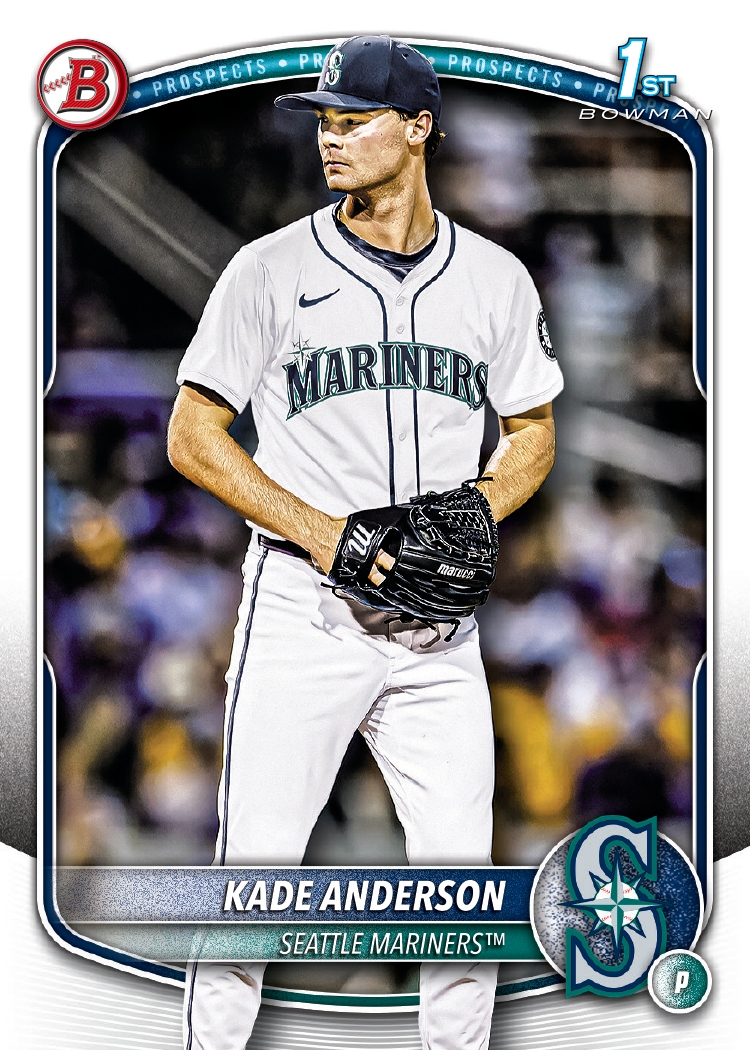
- Medium Risk: Kade Anderson, Seth Hernandez Anderson has more development relative to age and less immediate role clarity. Hernandez is only 19 and talented, but patience is required.
- High Risk: Liam Doyle Electric stuff and dominance, but concerns around delivery, effort, and starter viability push the risk higher from a hobby perspective.
This does not mean these pitchers cannot succeed. It means timing, role, and durability matter more for card value than raw stuff.
Fades
Liam Doyle (LHP) – We get the appeal: he’s a lefty with a monster fastball and he can absolutely mow down hitters when it’s on. But for early hobby purposes, the profile is just messy. The delivery is high-effort and a little unorthodox, which is exactly the combo that tends to create bullpen risk (and durability questions) the moment he hits pro ball. Even if he becomes a really good big-league arm, the “starter vs. reliever” fork in the road is brutal for Bowman value early, because reliever outcomes rarely carry the hobby the way frontline starters or premium bats do.
Hobby angle: We’d rather let this one prove it first. If he holds starter traits and shows he can repeat the delivery with pro workload, there will still be plenty of time to buy in. At release, you’re paying for the loudest version of the story while holding the most pitcher-specific risk.
Eli Willits (SS, Washington Nationals) – This is the classic “face of the product” trap. Willits has real upside, he was the No. 1 pick, and the checklist treatment is going to be massive. That usually means two things at release: prices are inflated across the board, and supply is everywhere because the product is built around him. Add in the reality that he’s a prep shortstop (timeline is longer, development is non-linear, early pro lines can be noisy), and the risk-reward just isn’t great if you’re buying at peak hype.
Hobby angle: We’re not fading the talent, we’re fading the entry price. If you want Willits exposure, the smarter play is patience: let the initial rip wave pass, let the market absorb the flood of autos and inserts, and look for a dip when the first normal teenager adjustment period happens. Nationals market strength is also not the same as the Dodgers, Yankees, or Cubs hobby machine, so you’re relying more on him being a true superstar than on team-driven demand holding the floor.
Market Dynamics to Consider
Bowman Draft team pricing is driven entirely by prospect concentration rather than MLB stars. There will be a Dream Draft Pick auto, but the name is to be announced (Tom Brady and John Elway being previous names). Teams with top-heavy draft classes will carry premiums early, while others quietly offer better value.
The Bottom Line
2025 Bowman Draft rewards patience and prospect selection.
Do not chase everything. Focus on players you believe in. Fade most pitchers. Let the market cool before committing too much to any one player.
The best Bowman Draft collections are built slowly, not at release.
Happy hunting, and remember—use that HobbyMonitor scanner before sending anything to grade!